



Aesthetic Clinic Website Design: What Actually Converts Visitors Into Consultations

What Aesthetic Clinic Website Design Actually Means

Aesthetic clinic website design is often treated as a visual exercise — pick a clean template, add the clinic’s logo and colors, upload some photos, done. That approach produces a site that looks presentable and converts almost nothing. Real aesthetic clinic website design is conversion engineering: every layout decision, every load-time optimization, and every gallery placement exists to move a stranger from “curious” to “consultation booked” as quickly and confidently as possible.

That distinction matters because an aesthetic clinic website carries a heavier trust burden than most local business sites. Patients are deciding who touches their face. They are evaluating credibility, safety, and results before they ever pick up the phone — and the website is usually the first place that evaluation happens. A site built only to look good, without that conversion logic behind it, quietly leaks the exact patients that local SEO and paid ads worked to bring in.

Key takeaway: An aesthetic clinic website has one job above all others — converting a trust decision into a booked consultation. Visual polish that doesn’t serve that job is decoration, not design.

The First 3 Seconds Decide Everything

A patient searching “Botox near me” or “lip filler [city]” on their phone decides whether your clinic feels credible before reading a single word of copy. Load speed, a clear treatment menu, and visible trust signals — reviews, credentials, before/after proof — all register in the first few seconds. If any one of those is missing or slow to appear, the visitor bounces back to the search results and books with whichever clinic showed up next.

This is the gap between a website that “looks nice” in a portfolio screenshot and one that actually converts in the wild. Aesthetic clinic websites live or die on three things working together: speed, a frictionless path to booking, and enough visible trust to make a stranger comfortable handing over their phone number for a consultation.

The Booking-Flow Pattern That Actually Converts

Most underperforming clinic websites make the same structural mistake: they treat a static contact form as the primary conversion path. Name, email, message, submit — buried in the footer or on a separate “Contact” page. That’s the highest-friction option available, and friction is exactly what a mobile visitor, often browsing between other tasks, will not tolerate.

The websites that convert instead offer multiple low-friction paths to the same outcome, surfaced repeatedly throughout the page:

  • Click-to-call — a tap-to-dial phone number in the header, visible on every scroll position on mobile.
  • Embedded booking widget — a calendar or consultation-request tool built directly into the page, not a link that opens a separate tab and loses the visitor.
  • Live chat or SMS — for visitors who have a specific question before they’re ready to commit to a call.

The principle behind all three: reduce the distance between “interested” and “action taken” to as few taps as physically possible. Every additional field, every extra click, every moment of uncertainty about what happens next is a point where a warm lead goes cold.

Mobile Speed Benchmarks

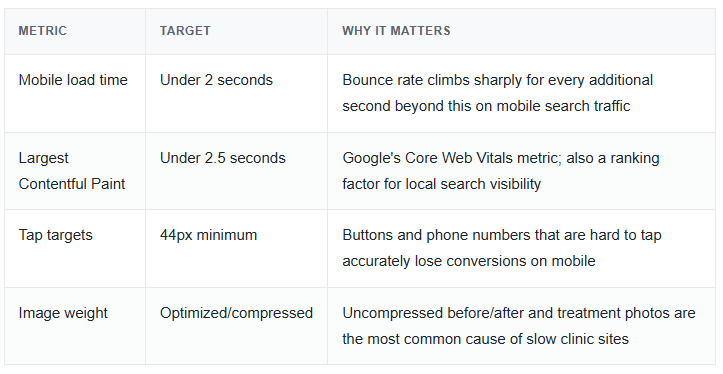
Most aesthetic clinic searches happen on a phone, frequently on the go. Speed isn’t a technical nice-to-have here — it’s a direct conversion variable, and it’s also a local SEO ranking factor.

Image weight deserves special attention in this category specifically because aesthetic clinics rely so heavily on visual proof. A gallery of ten uncompressed, full-resolution before/after photos can add several seconds to load time — the exact content meant to build trust ends up being what drives the visitor away before they see it.

Custom Build vs. Template vs. Website Builder

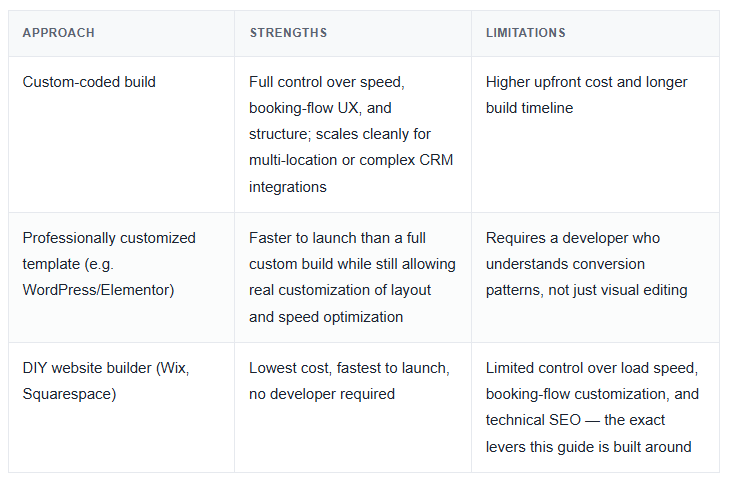
One of the first decisions a clinic faces is what the site is actually built on. Each option carries real tradeoffs, and the right answer depends on how much of the conversion logic above needs to be custom-engineered versus how much a generic tool can approximate.

DIY builders are not disqualifying for a brand-new clinic testing the waters, but most clinics that start there end up rebuilding within a year once the platform’s limitations start capping conversion rate and organic ranking. A professionally customized build is the practical middle ground for most established clinics.

Before/after galleries are one of the strongest trust signals an aesthetic clinic website can offer — and one of the easiest places to introduce compliance risk if the same imagery gets reused in ad campaigns later. Design the gallery with both goals in mind from the start:

  • Use full-face or full-context photography rather than tight crops on a single feature — this reads as more professional on the website and keeps the same images usable in Meta and Google ad campaigns without triggering review flags.
  • Caption results factually (treatment type, timeframe) rather than with language implying the patient had a “problem” beforehand.
  • Get documented patient consent for every image used, and keep records — a website gallery carries the same consent obligations as any marketing use of a patient’s likeness.

For the full advertising-specific rules around this imagery, see our companion guide on Botox & Filler Ad Compliance.

Homepage Anatomy: What Belongs Above the Fold

The homepage doesn’t need to say everything — it needs to say enough to earn the next click. A converting aesthetic clinic homepage typically leads with a clear headline naming the clinic’s core treatments and location, a visible primary call-to-action (book, call, or chat), and an immediate trust signal — a review count, a credential, or a single strong before/after image — before the visitor has to scroll.

Below that: a concise treatment menu that lets different visitors self-select (someone searching for injectables shouldn’t have to scroll past a laser hair removal section to find what they came for), then social proof, then a secondary CTA. Every section should end with another opportunity to book — the goal is that no matter where a visitor stops scrolling, there was already a clear next step available to them.

Key takeaway: Think of the homepage as a funnel with multiple exits, not a single page with one CTA at the bottom. A visitor who stops reading after the second section should still have seen a way to book.

Treatment Pages: Your Built-In SEO Foundation

Individual treatment pages — a dedicated page for injectables, one for laser, one for skin resurfacing — do double duty that a single combined “services” page cannot. They give search engines a specific, well-structured page to rank for each treatment-specific search (“Botox [city],” “laser hair removal [suburb]”), and they let a visitor who searched for one specific treatment land directly on relevant content instead of a generic overview they have to dig through.

Each treatment page should include what the treatment involves, typical results and timeframe, pricing guidance (even a range builds trust), relevant before/after proof, and its own booking call-to-action — effectively a mini version of the homepage’s conversion logic, scoped to one treatment. This structure is also what makes the site’s local SEO investment pay off — see our Local SEO & Google Maps Playbook for how these pages reinforce Map Pack visibility.

The Importance of Cybersecurity: Protecting Your Digital World

Technical Requirements: Security, Hosting & Integrations

Beyond visual design, an aesthetic clinic website carries technical obligations that a generic business site doesn’t. Lead forms and booking widgets on these sites regularly capture information a patient considers sensitive — the treatment they’re inquiring about, sometimes implicitly a health condition — so hosting, data handling, and integrations deserve the same scrutiny as the page design itself.

  • SSL and secure hosting as a baseline, not an add-on — both for patient trust and for search ranking.
  • Consent-compliant lead forms that clearly capture opt-in before any data feeds into email or SMS marketing.
  • Booking and CRM integrations that sync directly with the clinic’s scheduling system, so a web booking doesn’t require manual double-entry by front-desk staff.
  • Careful retargeting pixel configuration — the same privacy considerations covered in our Botox & Filler Ad Compliance guide apply directly to the website’s own tracking setup.

Multi-Location Website Considerations

Clinics operating across multiple locations need the site architecture to reflect that from the start rather than bolting it on later. Each location should have its own dedicated page with local NAP information, embedded map, location-specific reviews, and its own booking flow — not a single shared “Locations” page with a dropdown. This mirrors exactly what local SEO requires location-by-location, and it prevents one high-performing location from cannibalizing the search visibility of the others.

Common Mistakes That Quietly Kill Conversions

  • Generic template sites with stock photography instead of real clinic and provider imagery — patients are choosing who touches their face; generic stock photos actively undermine the trust the site is trying to build.
  • A single, buried contact form as the only path to action, often placed only on a separate “Contact” page.
  • Slow-loading, uncompressed galleries that push load time well past the point where mobile visitors bounce.
  • One combined services page instead of individual treatment pages, sacrificing both SEO visibility and on-page conversion clarity.
  • No mobile-specific design review — a site that was only ever checked on a desktop monitor, when the majority of traffic arrives on a phone.

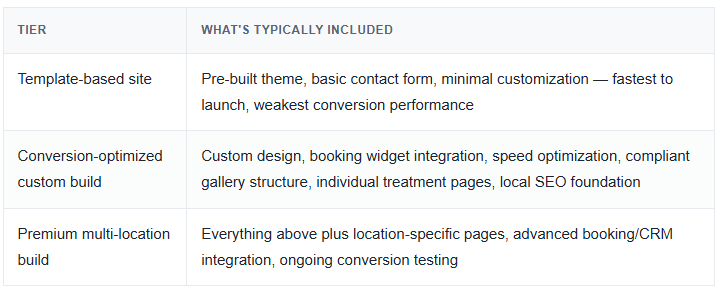
What a Conversion-Ready Website Costs

Pricing varies by scope, but as a general guide, clinics should expect cost to track with how much conversion engineering (booking widgets, speed optimization, compliant gallery structure, individual treatment pages) is built in versus a template swap with new logos and colors.

After Launch: Testing, Maintenance & Ongoing Optimization

An aesthetic clinic website is not a one-time deliverable — it’s an asset that needs upkeep to keep converting as well on day 400 as it did on day one. That means regular security and plugin updates, periodic speed audits as new images and content get added, conversion testing on the booking flow (small changes to CTA wording or placement can move booking rates meaningfully), and refreshing the gallery and testimonials on a regular cadence so the site doesn’t visibly stagnate. Clinics that treat launch as the finish line typically see conversion rate quietly erode over twelve to eighteen months as the rest of the industry moves forward around them.

Frequently Asked Questions

Does an aesthetic clinic website need to be custom-built, or is a template enough?

A template can work as a starting point, but most templates aren’t built with medical-aesthetic booking flows or compliant gallery structures in mind — clinics that start there often rebuild within a year once conversion problems show up.

Under two seconds is the practical target. Beyond that, bounce rate on mobile search traffic climbs quickly, particularly for the high-intent, on-the-go searches typical of this category.

Yes — website galleries and ad creative have different (though overlapping) rules. Website-only galleries have more room for full case documentation, while anything repurposed into paid ads needs to meet Meta and Google’s stricter imagery standards.

Yes, where practical — individual treatment pages outperform one combined services page for both search visibility and on-page conversion clarity, since each page can speak directly to a specific search intent.

Plan on ongoing maintenance rather than a set-and-forget approach — security updates as needed, a speed audit at least twice a year, and fresh testimonials or gallery content on a regular cadence.

Takeaway: The Website Is Phase One, Not a Side Project

Every other channel — local SEO, content, paid ads — sends traffic to the website. If that website is slow, template-generic, or buries its booking action, every dollar spent upstream underperforms. Getting the site right first, and keeping it right after launch, is what makes every later marketing investment pay off faster.

This guide sits alongside our Complete Guide to Digital Marketing for Aesthetic Clinics as the dedicated resource for the Web Development side of that framework.

Ready for a website that turns visitors into booked consultations?

Picture of Queen
Queen

Related Articles

Blogs
queen mercado

Local SEO & Google Maps Playbook for Aesthetic Clinics

Appearing in Google’s Map Pack is essential for capturing high-intent, local patient searches when they are ready to book. This playbook outlines how to optimize your Google Business Profile, align NAP citations, and build a review acquisition system to dominate local search results.

Read More »