



Local SEO & Google Maps Playbook for Aesthetic Clinics

What Local SEO Actually Means for an Aesthetic Clinic

Local SEO is often lumped in with general SEO, but for an aesthetic clinic the two behave very differently. Organic content SEO rewards depth, authority, and time — a blog post can climb rankings gradually over months of accumulated relevance. Local SEO rewards a specific, checkable set of signals tied to a physical location: how complete your Google Business Profile is, how consistent your business information is across the web, and how actively patients are reviewing you right now. It’s less about writing the best article and more about being the most verifiably real, active, and trustworthy clinic in a specific geographic radius.

That distinction matters because it changes where effort should go. A clinic that invests heavily in blog content while ignoring its Google Business Profile is optimizing the wrong layer — the Map Pack, not the organic blue links below it, is where most local aesthetic searches get resolved.

Why the Map Pack Decides the Click

When someone searches “Botox near me” or “filler clinic [suburb],” Google shows a three-listing Map Pack above the standard organic results, complete with photos, ratings, and a one-tap call button. For a large share of local searches, the patient never scrolls past it. If your clinic isn’t one of those three listings, you’re not losing a ranking position — you’re invisible to the exact searchers who are ready to book today.

Key takeaway: A search for “Botox near me” reflects the highest commercial intent a clinic can capture — and it’s decided almost entirely by Map Pack visibility, not by how good your website’s blog content is.

The 3 Ranking Factors Google Actually Uses

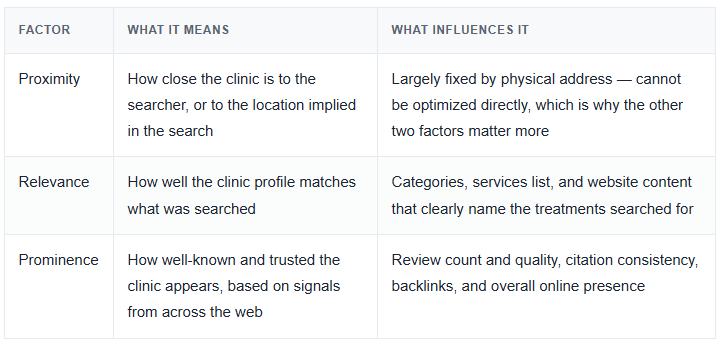
Google’s local ranking system is built around three factors, and understanding them makes every tactic below make more sense as part of a system rather than a checklist to complete once.

Because proximity is largely out of a clinic’s control, relevance and prominence are where local SEO effort should concentrate — which is exactly what the Google Business Profile checklist, citation work, and review system below are built to influence.

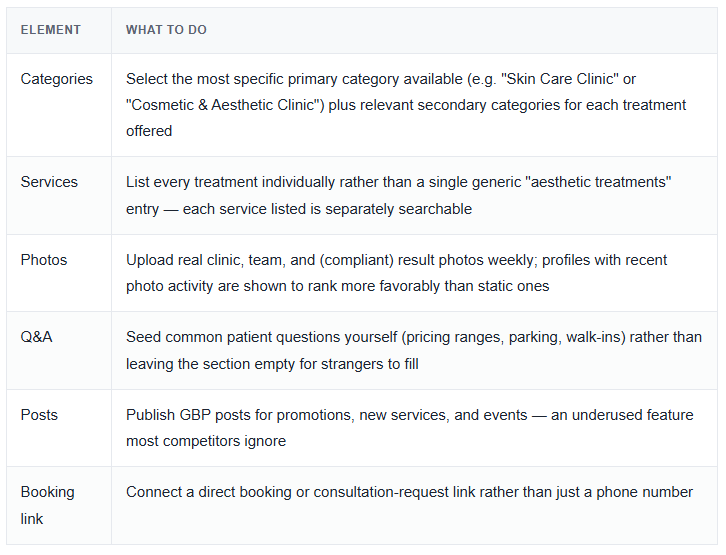
Google Business Profile Checklist

Your Google Business Profile (GBP) is the single highest-leverage local SEO asset a clinic controls. Most underperforming profiles are missing several of the items below, not because they’re hard to fix, but because no one has gone through them systematically.

NAP Citation Consistency

NAP stands for Name, Address, Phone — the three pieces of information that need to match, character for character, everywhere your clinic is listed online. Inconsistent NAP data (a suite number missing on one directory, an old phone number lingering on another) is one of the quieter reasons a clinic’s Map Pack ranking stalls despite an otherwise strong profile.

  • Audit your listing on the major directories relevant to your market and correct any mismatched name, address, or phone formatting.
  • Use the exact same formatting everywhere — abbreviations, suite numbers, and punctuation should match your GBP listing precisely.
  • Update every listing simultaneously if the clinic moves, rebrands, or changes its phone number — a single stale citation can measurably slow down a Map Pack recovery.

The Review Acquisition System

Review count matters, but review velocity and recency matter more — Google’s local algorithm reads a steady stream of new reviews as a signal of an active, trustworthy business, not just a historically well-liked one. A clinic with 150 reviews from three years ago and nothing since is at a real disadvantage against a newer competitor earning five fresh reviews a week.

A workable system looks like this: ask at the moment of highest patient satisfaction (immediately after a visible result, not days later by email when the moment has passed), make the request as low-friction as possible (a direct link, not a search-and-find task), and follow up once if there’s no response within a few days. Respond to every review, positive or negative — professional responses to negative reviews are themselves a trust signal to future patients reading them.

Key takeaway: Review velocity and recency function as ranking signals, not just as trust signals for patients — a dormant review profile quietly costs Map Pack position even if the star rating itself is excellent.

On-Page Local SEO Signals

Local SEO isn’t limited to the Google Business Profile — the website itself carries local signals too. Location-specific landing pages, consistent NAP information in the website footer, an embedded Google Map, and schema markup identifying the business as a local medical/health entity all reinforce the same local relevance signals Google is already checking via GBP and citations. Individual treatment pages matter here as well — a dedicated page for each treatment gives Google specific, well-structured content to match against treatment-specific local searches. See our Aesthetic Clinic Website Design guide for how treatment pages should be structured.

Local Links & Community Signals

Prominence — the third ranking factor above — is also built through signals from outside your own website and Google profile. Local backlinks and mentions carry real weight: partnerships with nearby complementary businesses (hair salons, wellness studios, bridal boutiques), sponsorships of local events, membership in local business associations, and press coverage from local news or lifestyle publications all reinforce that the clinic is a genuine, established part of its community — a signal that’s difficult for a newer or less-connected competitor to replicate quickly.

Multi-Location Local SEO

Clinics with more than one location need a fundamentally different local SEO structure than a single-location practice. Each location requires its own Google Business Profile, its own dedicated website page with unique NAP information and location-specific reviews, and its own citation footprint — rather than one shared listing or page trying to represent every location at once. Done well, this lets each location compete independently for its own local Map Pack instead of diluting relevance across all of them. This mirrors the multi-location approach covered in our Aesthetic Clinic Website Design guide.

Tracking & Reporting Local Rankings

Local ranking is harder to track than a standard organic keyword position because Map Pack results shift based on the searcher’s exact location. Rather than checking rank from a single computer, use rank-tracking tools built for local search that simulate searches from multiple points around the clinic’s service area, and pair that with your Google Business Profile’s own performance data — views, direction requests, calls, and website clicks originating directly from the profile. Together these two data sources show not just whether rankings are improving, but whether that visibility is actually converting into contact.

Common Mistakes That Stall Map Pack Rankings

  • An incomplete or stale GBP profile — missing services, outdated hours, no recent photos.
  • Inconsistent NAP data across directories, often left over from a past address or rebrand.
  • A review acquisition process that relies on hoping patients remember rather than asking at the right moment with a low-friction link.
  • Ignoring negative reviews instead of responding professionally — an unanswered negative review reads worse to prospective patients than one with a thoughtful response.
  • One shared listing for multiple locations instead of a dedicated profile and page per location.

How Long Local SEO Takes to Show Results

Local SEO is a compounding channel, not an instant one. Citation cleanup and GBP optimization can show early movement within weeks, but meaningful, durable Map Pack gains typically build over several months of consistent citation, review, and content work — steady improvement rather than a single fix that flips rankings overnight.

Frequently Asked Questions

How important is a Google Business Profile compared to the website itself?

For local, high-intent searches like “Botox near me,” the GBP is often what a patient sees and acts on first — the website matters most once they click through to verify credibility and book.

Engagement signals like review responses contribute to the overall activity profile Google associates with a listing, and they meaningfully influence how prospective patients perceive the clinic when reading reviews before booking.

There’s no fixed threshold — consistent, recent review velocity relative to local competitors matters more than hitting a specific total count.

No — each physical location needs its own profile and page. A shared listing prevents any single location from ranking well in its own local Map Pack.

A full Google Business Profile audit and completion pass — categories, services, photos, and a booking link — since it’s the fastest, most controllable lever before citation and review work compound over time.

Takeaway: Local SEO Is a System, Not a One-Time Setup

Winning the Map Pack isn’t about a single optimization pass — it’s an ongoing system of profile completeness, citation consistency, review velocity, and community signals that compounds over months. Clinics that treat it as a “set it and forget it” task watch their ranking erode as competitors stay active.

This guide sits alongside our Complete Guide to Digital Marketing for Aesthetic Clinics as the dedicated resource for the SEO side of that framework.

Want your Google Business Profile audited for Map Pack readiness?

Picture of Queen
Queen

Related Articles

Blogs
queen mercado

Local SEO & Google Maps Playbook for Aesthetic Clinics

Appearing in Google’s Map Pack is essential for capturing high-intent, local patient searches when they are ready to book. This playbook outlines how to optimize your Google Business Profile, align NAP citations, and build a review acquisition system to dominate local search results.

Read More »