



Digital Marketing for Aesthetic Clinics: The Complete Guide to Bookings, Local SEO & Compliant Ads

What Is Digital Marketing for Aesthetic Clinics?

Digital marketing for aesthetic clinics is the combination of website conversion design, local SEO, content, and paid advertising an aesthetic clinic uses to turn nearby, high-intent searchers into booked consultations. Unlike standard e-commerce or B2B marketing, it has to do double duty: generate demand and build enough trust to get a patient into the consultation chair for a treatment they’ll wear on their face or body.

This guide focuses on the three core disciplines every aesthetic clinic needs to get right — web developmentSEO, and paid advertising — with compliant content and social proof woven through each rather than treated as a separate project.

Three forces make this category unique:

  • Trust is the product before the treatment is. Patients convert on proof — reviews, before/afters, injector credentials — not discount codes.
  • Visual validation drives the funnel. Aesthetic decisions are made with the eyes first, so platforms built around imagery and video (Instagram, TikTok, Google Business Profile photos) carry disproportionate weight.
  • Geographic intent is non-negotiable. Nobody flies across the country for a routine Botox appointment. Demand is hyper-local, which makes Google Maps visibility and local SEO foundational, not optional.

Core Channels by Clinic Type

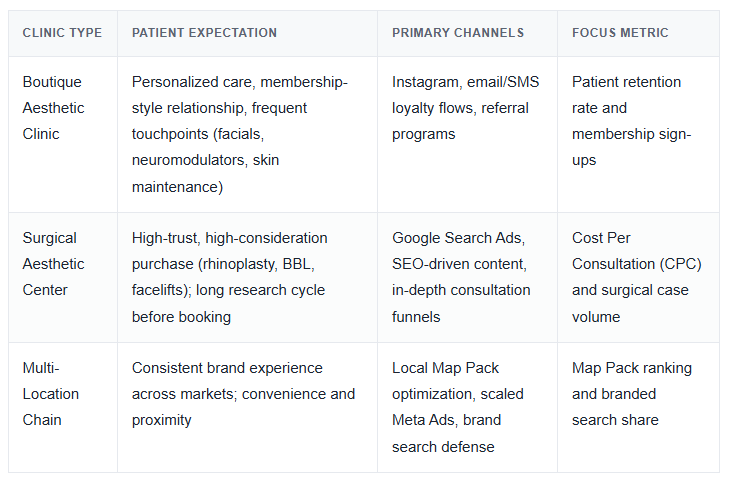
Because “aesthetic clinic” isn’t one business model, the right channel mix depends heavily on what kind of practice you’re running.

Key takeaway: There is no universal aesthetic marketing playbook. A boutique aesthetic clinic optimizing for retention and a surgical center optimizing for high-ticket consultations need fundamentally different budget allocations, ad creative, and KPIs — even if they’re both “aesthetic clinics” on paper.

A man is struggling to click on a website using his phone

Symptoms of Broken Aesthetic Marketing

If you’re reading this, chances are something isn’t working. Maybe your current agency reports “great numbers” every month, but your appointment book doesn’t reflect it. Here are the three most frequent symptoms of underperforming aesthetic marketing programs.

Symptom 1: High Lead Volume, Zero Bookings

Your ad account shows 200 leads this month; your front desk shows six actual bookings. This is the classic cheap-lead trap — broad, un-vetted targeting that fills your CRM with people who clicked out of curiosity, not intent. They’re not local, not qualified on budget, and not ready to book a $1,200 treatment.

Key takeaway: Lead volume is a vanity metric in disguise. If cost-per-lead looks great but your front desk is chasing ghosts, your targeting — not your front desk — is the problem.

Symptom 2: Invisibility on Google Maps

A patient searches “lip filler near me” or “Botox [your city]” and your clinic doesn’t appear in the top three Map Pack results. The patient books with whichever practice does show up — often a competitor with a fraction of your experience but a stronger Google Business Profile. That search reflects the highest possible commercial intent, and you’re not even in the room.

Symptom 3: Low Patient Lifetime Value (LTV)

The patient comes in for one filler syringe, has a great experience, and never hears from you again. No rebooking sequence, no cross-sell into complementary treatments, no retention flow. You paid full acquisition cost for a single transaction when that same patient could have been worth 5–10x more over 24 months.

Key takeaway: A clinic that only measures new-patient acquisition and ignores retention is running its business at a structural loss — the real profit in aesthetics lives in the second, third, and fourth visit.

The 4-Phase Growth Framework (Your Strategy Build Order)

Fixing the symptoms above requires a sequential build, not a scattershot of tactics. Skipping a phase — running ads before the website converts, or chasing SEO before local listings are cleaned up — is the single biggest reason aesthetic marketing budgets get wasted.

Phase 1: Conversion-First Website

  • Sub-2-second load speed on mobile — most aesthetic searches happen on a phone, often between other tasks.
  • Mobile-first booking flow with as few clicks as possible between “interested” and “consultation scheduled.”
  • Frictionless calls-to-action — click-to-call, embedded booking widgets, and live chat, not a static contact form buried in the footer.

Phase 2: Local SEO & Google Maps

  • A fully optimized Google Business Profile (categories, services, photos, Q&A, posts).
  • Consistent NAP (Name, Address, Phone) citations across directories.
  • A steady, authentic review acquisition system — review velocity and recency are ranking factors, not just trust signals.

Phase 3: Social Proof & Content

  • Before-and-after protocols that are compliant, consistent, and results-driven (see compliance section below).
  • Video walkthroughs of the clinic, consultation process, and patient experience — reducing anxiety around an unfamiliar procedure.
  • Injector authority content — bios, credentials, technique explainers — that position your providers as the expert choice, not a commodity.

Phase 4: Targeted Ad Campaigns

  • Google Search Ads to capture high-intent, bottom-of-funnel searches from patients who already know what treatment they want.
  • Meta Ads to generate visual demand among people who don’t yet know they want a treatment — using content built in Phase 3 as ad creative.

Key takeaway: Ads amplify what’s already working. If Phases 1–3 aren’t built, paid media just accelerates the rate at which you burn budget on a broken funnel.

Ad Platform Compliance: Risks You Can't Ignore

Aesthetic clinics operate in one of the most heavily policed advertising categories on both Meta and Google. Getting flagged isn’t a slap on the wrist — it’s frequently a permanent ad account ban, and appeals in the health/medical category are notoriously difficult to win.

The Before/After Trap

Meta’s policies on personal health and appearance are strict and heavily enforced by automated review. Common triggers for rejection or bans include zooming tightly on a body part to imply a flaw, side-by-side imagery emphasizing negative self-perception, and any implication that the viewer has a condition the ad is targeting them for.

Safer approach: use full-face or full-context imagery, neutral and factual captions, and avoid language implying the viewer’s body is currently a “problem.”

The Trademark Rule

Manufacturer brand names — Botox®, Juvederm®, Dysport®, Sculptra®, and similar pharmaceutical trademarks — are protected IP. Bidding on or prominently using these terms in ad copy generally requires explicit authorization from the manufacturer or its ad-network partner.

Safer approach: default to generic category terms — “neuromodulator treatments,” “dermal fillers,” “injectables” — and confirm your trademark usage rights before running branded campaigns.

Patient Privacy & Regulations

Every contact form, landing page, and email list handles protected health information the moment a patient names a condition or treatment interest. Review lead-gen forms and CRMs for HIPAA-aligned (or local equivalent) data handling, configure retargeting pixels carefully, and capture proper consent for email/SMS lists.

Key takeaway: In most industries, an ad account ban is an inconvenience. In aesthetics, it can mean the sudden loss of your #1 patient acquisition channel overnight — compliance is a growth-protection strategy, not a legal afterthought.

Measuring ROI: The Diagnostic Dashboard

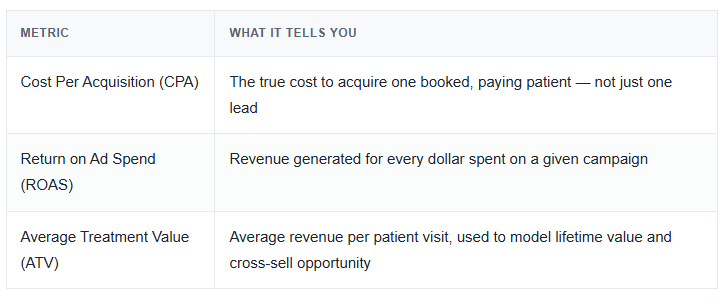
Most clinics get handed a monthly report full of numbers that feel good but mean nothing for the P&L. Knowing which metrics to ignore is as important as knowing which ones to track.

Vanity metrics to ignore in isolation: social media likes and followers, ad impressions and reach, raw click volume with no attached conversion data.

Key takeaway: A dashboard that only shows clicks and impressions is a vanity dashboard. One that ties every dollar spent to CPA, ROAS, and ATV is a revenue dashboard — the only kind that should drive your budget decisions.

Step 7: Measuring Your Website's Success for a successful website development in the Philippines.

Budget Benchmarks: Where to Put Your Money First

Clinics often ask how to split a limited marketing budget. As a general planning guide — not a guaranteed formula — allocation should follow the build order in the framework above rather than jumping straight to ads:

  • New or under-converting website: weight spend toward conversion-focused web development and local SEO first; a faster, better-converting site raises the return on every dollar spent later on ads.
  • Established site, weak local visibility: prioritize Google Business Profile optimization, citations, and review acquisition before increasing ad spend.
  • Strong foundation, flat growth: this is the stage where scaling Google Search Ads and Meta Ads produces the best marginal return, since the funnel behind them already converts.

Exact budget figures vary widely by market (Australia vs. the Philippines), clinic type, and competitive density, so treat this as a sequencing guide rather than a fixed percentage split.

Choosing the Right Digital Marketing Partner

Running Phases 1–4 well, on top of ad compliance and a real ROI dashboard, is rarely a one-person or one-tactic job. When evaluating an agency or in-house hire, look for:

  • Aesthetic-specific portfolio — proof they’ve built for aesthetic clinics, boutique studios and surgical centers alike, not just general local businesses.
  • Compliance fluency — a documented understanding of Meta and Google’s health-and-appearance ad policies before your account gets flagged, not after.
  • One integrated engine — web development, local SEO, content, and paid media managed as a single system, rather than four disconnected vendors that don’t talk to each other.
  • Revenue reporting — CPA, ROAS, and ATV in every report, not just impressions and likes.

Digital Services Master builds and manages this system specifically for aesthetic and dental clinics across Australia and the Philippines, treating compliance, local SEO, content, and paid media as one integrated engine rather than four disconnected vendors.

Frequently Asked Questions

How much does digital marketing cost for an aesthetic clinic?

Cost depends on clinic type, market, and how much foundational work (website, local SEO) is already in place. Clinics with a converting website and strong local SEO typically need a smaller ad budget to hit the same booking target than clinics starting from scratch.

Start with a conversion-ready website and Google Business Profile optimization — these capture patients who are already searching with intent — before layering in Meta Ads to build visual demand.

Local SEO is a compounding channel rather than an instant one; most clinics see meaningful Map Pack movement over several months of consistent citation, review, and content work, with results building steadily rather than overnight.

Yes, but with restrictions. Avoid using protected manufacturer trademarks without authorization, use full-context (not zoomed-in) imagery, and avoid copy implying the viewer currently has a “problem.” See the compliance section above for specifics.

Takeaway: Next Steps

Aesthetic marketing sits at the intersection of high-trust healthcare decisions, visual demand generation, and some of the strictest ad compliance rules in digital advertising. Getting all three right simultaneously — a converting website, dominant local visibility, compelling and compliant social proof, precisely targeted ad campaigns, and a revenue-focused measurement system — is a system, not a single tactic.

Clinics that try to run this system with a generalist agency, or in-house without specialized experience, tend to hit the exact symptoms outlined above: expensive leads that don’t book, invisibility where it matters most, and patients who never come back.

Ready to fix the leaks in your patient acquisition funnel?

Picture of Queen
Queen

Related Articles

Blogs
queen mercado

Local SEO & Google Maps Playbook for Aesthetic Clinics

Appearing in Google’s Map Pack is essential for capturing high-intent, local patient searches when they are ready to book. This playbook outlines how to optimize your Google Business Profile, align NAP citations, and build a review acquisition system to dominate local search results.

Read More »