

Google Ads for Aesthetic Clinics: Complete Campaign Setup Guide

What Google Ads Actually Does for an Aesthetic Clinic

Google Ads occupies a specific, valuable position in a clinic’s marketing mix: it captures demand that already exists. Someone searching “Botox near me” or “lip filler [city]” has already decided to look for a provider — Google Ads puts your clinic in front of that person at the exact moment of highest intent, ahead of organic results and often ahead of your own Google Business Profile listing. That’s fundamentally different from what Meta and Instagram ads do (creating demand among people who weren’t actively searching) and different from what local SEO does (earning that same visibility for free, but on a much longer timeline).

Done well, Google Ads is the fastest lever a clinic has to fill a specific gap in the appointment book. Done without structure, it’s the fastest way to spend a marketing budget on clicks that were never going to convert.

Why Aesthetic Clinics Need a Different Playbook

A generic local-business Google Ads setup — one campaign, broad match keywords, a handful of ad groups — will spend a clinic’s budget quickly and produce very little of value. Aesthetic clinic search traffic splits sharply by treatment type, price point, and how close the searcher is to booking, and a campaign structure that doesn’t reflect that reality ends up paying for clicks that were never going to convert.

It’s also one of the more heavily regulated advertising categories on the platform. Getting the account structure and policy compliance right from the outset avoids both wasted spend and the disruption of a policy review mid-campaign

Campaign Structure by Treatment Category

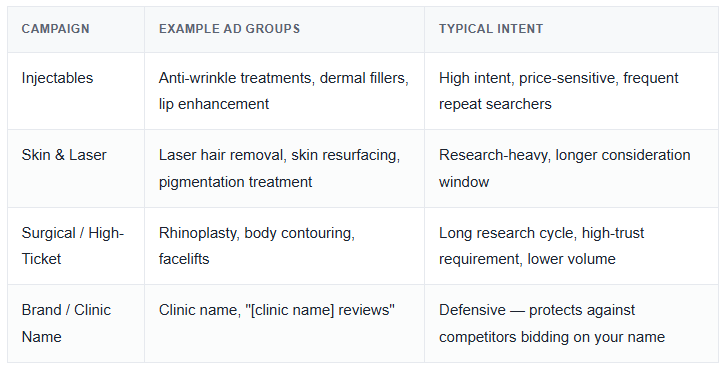
The single highest-leverage decision in an aesthetic clinic Google Ads account is splitting campaigns by treatment category rather than running everything through one generic “clinic services” campaign. This keeps ad copy, landing pages, and budgets aligned to genuinely different searcher intents.

Each campaign should map to its own landing page, not the homepage — a searcher clicking an injectables ad should land on a page about injectables, not a general services page they have to navigate further from.

Account Structure Fundamentals

Underneath the campaign-by-treatment structure above sits Google Ads’ own hierarchy: account, then campaigns, then ad groups within each campaign, then keywords and ads within each ad group. The discipline that separates a well-run account from a messy one is keeping ad groups tightly themed — a single ad group for “anti-wrinkle treatments” should contain only closely related keyword variants, with ad copy written specifically for that theme, rather than one broad ad group covering every injectable treatment with generic ad copy trying to speak to all of them at once. Tight ad groups are what make strong Quality Scores and relevant ad copy possible at scale.

The Negative Keyword List Every Clinic Account Needs

Negative keywords prevent budget from being spent on searches that will never convert. Aesthetic clinics in particular attract a predictable set of low-intent searches that should be excluded from day one:

  • Job and career terms: “jobs,” “careers,” “hiring,” “salary” — filters out people searching for employment, not treatment.
  • Education and training terms: “course,” “training,” “certification,” “how to become” — filters out aspiring practitioners rather than patients.
  • DIY and home-remedy terms: “at home,” “DIY,” “natural alternative” — filters out searchers who were never going to book a clinic visit.
  • Free and discount-hunting terms: “free,” “cheap,” “voucher code” — filters out the least profitable segment of traffic for a premium service category.

Strong ad copy in this category is specific and factual rather than promotional — naming the exact treatment, the clinic’s location, and a clear next step outperforms generic “book your dream look today” language, which tends to read as exactly the kind of unverifiable claim Google’s healthcare ad policies discourage. Extensions matter as much as the ad copy itself: call extensions let a high-intent searcher skip the website entirely and dial directly from the search results, location extensions reinforce the proximity signal that matters so much in local search, and sitelink extensions can point directly to individual treatment pages, giving the searcher a faster path to the specific service they’re looking for.

Landing Page Requirements

A Google Ads campaign is only as strong as the page it sends traffic to. Every landing page behind an aesthetic clinic campaign should load in under two seconds on mobile, feature a single clear call-to-action above the fold (call, book, or chat — not a menu of five competing options), and match the ad’s specific claim exactly, since Google penalizes and patients distrust a mismatch between what an ad promises and what the page delivers. For the full framework behind this, see our guide on Aesthetic Clinic Website Design.

Conversion Tracking Setup

An account can look perfectly optimized and still be flying blind without proper conversion tracking. At minimum, a clinic’s account needs call tracking (so phone calls generated by the ad are attributed correctly, not lost as an untracked action), form-fill tracking on every landing page, and ideally offline conversion imports that connect an actual booked-and-attended consultation back to the specific ad and keyword that generated the original lead. Without this last step, the account’s automated bidding is optimizing toward form submissions and calls — not toward the patients who actually showed up and paid, which is the number that matters to the business.

Key takeaway: A click and a booked consultation are not the same event. An account without conversion tracking connected all the way through to an actual attended appointment is optimizing for the wrong outcome by default.

Quality Score & Ad Rank

Google’s Quality Score — built from expected click-through rate, ad relevance, and landing page experience — directly affects both cost per click and ad position. Tightly themed ad groups (see Account Structure Fundamentals above), ad copy that closely matches the keywords in that ad group, and a fast, relevant landing page all feed directly into a higher Quality Score, which in practice means paying less for the same or better ad position than a generic, loosely structured account.

Budget Benchmarks by Clinic Type

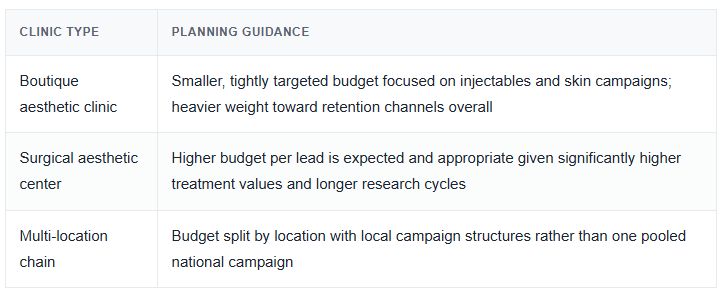
Exact figures vary by market and competitive density, but as a general planning guide, budget allocation should reflect the clinic type and its typical booking value:

Treat this as sequencing guidance rather than a fixed percentage split — see the Budget Benchmarks section of our Complete Guide for how ad spend should sequence against website and local SEO investment.

Bidding Strategy Notes

Automated bidding strategies like Maximize Conversions or Target CPA can work well for aesthetic clinics once a campaign has enough conversion history for the algorithm to optimize against — typically after the first few weeks of consistent data. Broad automated strategies like Performance Max deserve extra caution in this category: their broader inventory and automated creative matching make it harder to guarantee the strict imagery and copy compliance this category requires, so many clinics keep Performance Max separate from, or excluded entirely from, their compliance-sensitive campaigns.

Compliance & Certification Considerations

Google’s Healthcare and Medicines policy applies to most aesthetic treatment campaigns, and depending on your market, healthcare advertiser certification may be required before ads for certain treatments are eligible to run at all. Trademark terms — Botox®, Juvederm®, Dysport®, Sculptra®, and similar — generally require manufacturer authorization before they can be used in ad copy or bid on directly. See our dedicated guide on Botox & Filler Ad Compliance for the full detail on imagery rules, trademark use, and account-ban recovery, since the same policies that govern Meta ads apply in parallel to Google’s healthcare category.

Measuring Success: Beyond Clicks and Impressions

A Google Ads report full of impressions, clicks, and cost-per-click tells you almost nothing about whether the campaign is working. The metrics that matter are Cost Per Acquisition (the true cost of one booked, paying patient, not just a lead or a click), Return on Ad Spend, and how that acquisition cost compares to Average Treatment Value. See the ROI Dashboard section of our Complete Guide for the full measurement framework.

Common Mistakes That Waste Ad Spend

  • One generic campaign for every treatment instead of structure split by treatment category, diluting ad relevance and Quality Score.
  • No negative keyword list, allowing job seekers, DIY searchers, and bargain hunters to consume budget meant for real patients.
  • Sending every ad to the homepage instead of a matched, treatment-specific landing page.
  • Missing conversion tracking beyond a basic click count, leaving automated bidding to optimize toward the wrong outcome.
  • Turning on Performance Max without a compliance review, given the category’s strict imagery and copy requirements.

Frequently Asked Questions

How much should a new aesthetic clinic budget for Google Ads?

It depends heavily on how much foundational work — a converting website, local SEO — is already in place; a strong foundation makes every ad dollar go further, so budget should scale with readiness rather than following a fixed formula.

Bidding on competitor brand terms is technically permitted on Google Ads but is a separate strategic and ethical decision from generic category bidding — weigh it against your own brand-defense needs first.

Yes — these terms carry specific compliance and trademark considerations covered in our Botox & Filler Ad Compliance guide, and keeping them in dedicated campaigns makes those rules easier to audit and enforce.

Most accounts need several weeks of consistent conversion data before automated strategies like Target CPA optimize reliably — starting with manual or conversion-based bidding and switching once data accumulates is generally safer than automating from day one.

Yes — without call tracking, calls generated by the ad aren’t attributed back to the specific campaign or keyword, which means the account’s bidding has no visibility into one of its most valuable conversion types.

Takeaway: Structure Is What Makes Ad Spend Efficient

Google Ads amplifies whatever it’s pointed at. A well-structured account — split by treatment, backed by a solid negative keyword list, tracked all the way through to a booked and attended consultation — turns budget into revenue. A generic, unstructured, untracked account just turns budget into clicks.

This guide sits alongside our Complete Guide to Digital Marketing for Aesthetic Clinics as the dedicated resource for the paid search side of that framework.

Want your Google Ads account structured for compliance and conversions?

Picture of Queen
Queen

Related Articles

Blogs
queen mercado

Local SEO & Google Maps Playbook for Aesthetic Clinics

Appearing in Google’s Map Pack is essential for capturing high-intent, local patient searches when they are ready to book. This playbook outlines how to optimize your Google Business Profile, align NAP citations, and build a review acquisition system to dominate local search results.

Read More »